

City developers don’t like graveyards.
When now-prime real estate is generously peppered with stones and bones, it can be challenging to come up with a cohesive plan.
It is so much easier to exhume tens of thousands of bodies, relocate them to mass graves, and use their left-behind headstones for new infrastructure projects, like sea walls and rain gutters.
Buena Vista Park
Established in 1867-68 as Hill Park, San Francisco’s Buena Vista Park feels like a forested escape room in the middle of the city. A spectacular mix of Coast Live Oak trees, decomposing wooden stairs nestled into slope sides, mossy paved trails, and pieces of grave markers artfully arranged at your feet.
Enter at the intersection of Waller Street and Buena Vista Ave W, near the Buena Vista Playground
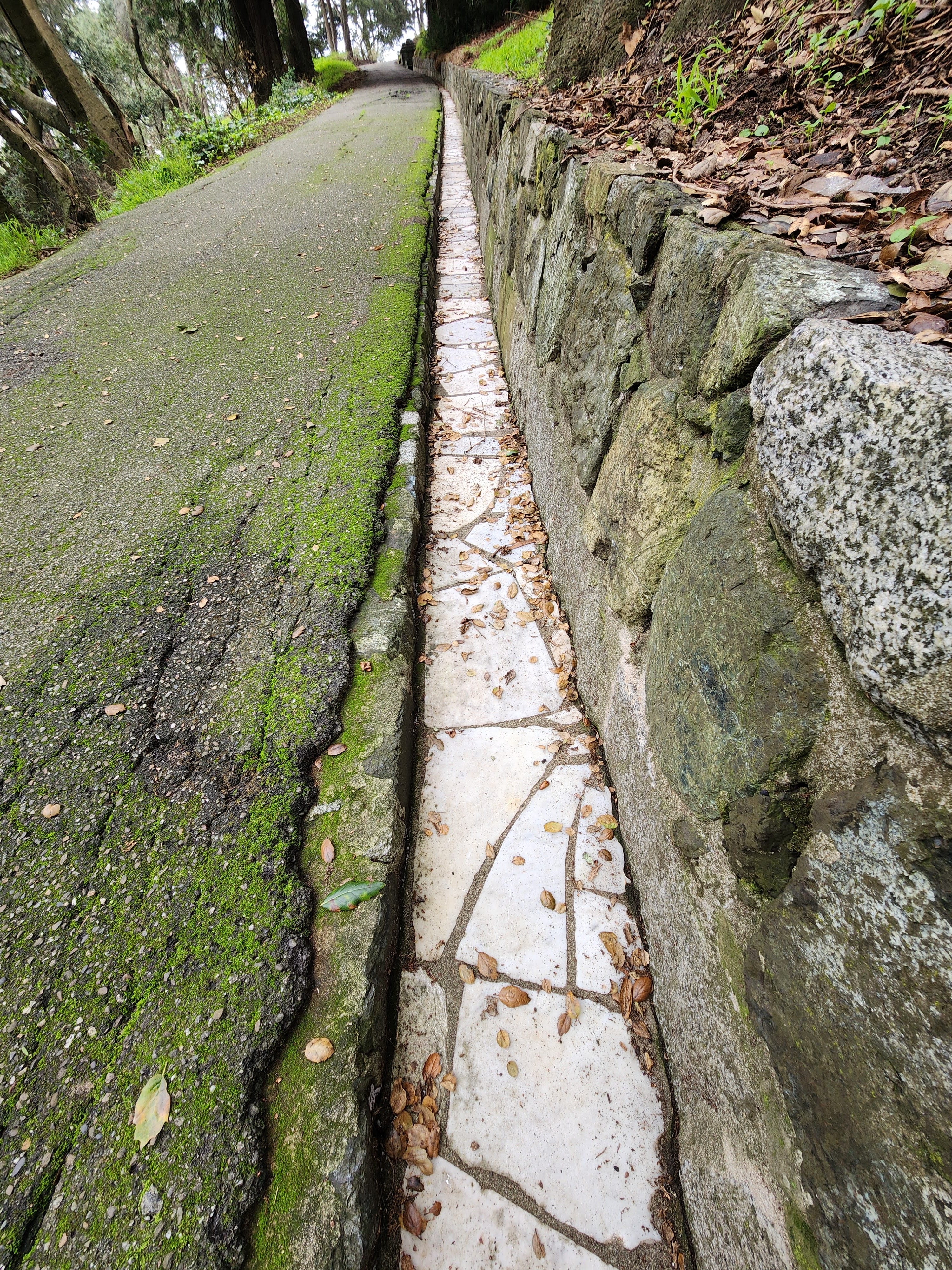
The marble mosaics weren’t an original feature of the park. They were added over 50 years later when the Department of Public Works inherited tons of deserted headstones and mausoleums — and people needed jobs.
Great Depressions in the ground
Throughout the 1930s, 120,000-150,000 bodies were dug up to make space for city development projects. After decades of public opposition to the idea, including cemetery administrators ignoring ordinances and new state laws, San Francisco voters had finally okayed the eviction of their subterranean neighbors residing in Laurel Hill, Calvary, Masonic, and Odd Fellows cemeteries.
The exhumed were moved and reburied in nearby towns or stored away until this three-acre mass burial mound was ready for them.
But when families were contacted about also relocating their relative’s grave marker, most couldn’t afford the cost. So the stones stayed behind. (I’ll never get over the audacity of asking families to pay for headstone transportation.)
The Department of Public Works used some of the largest stones for sea walls and highway bedding. Others were used for a 1986 public art installation, The Wave Organ.
The fact that there were still so many of these cemetery relics available in the 1980s to construct The Wave Organ demonstrates just how much was left behind in the 1930s.
- Rae Alexandra, “Beyond the Grave: How Old Tombstones Became Part of the Fabric of San Francisco”
Thanks to FDR’s Works Progress Administration — an agency that created millions of public jobs during the Great Depression — smaller headstones (and at least one mausoleum chunk) made their way to Buena Vista.
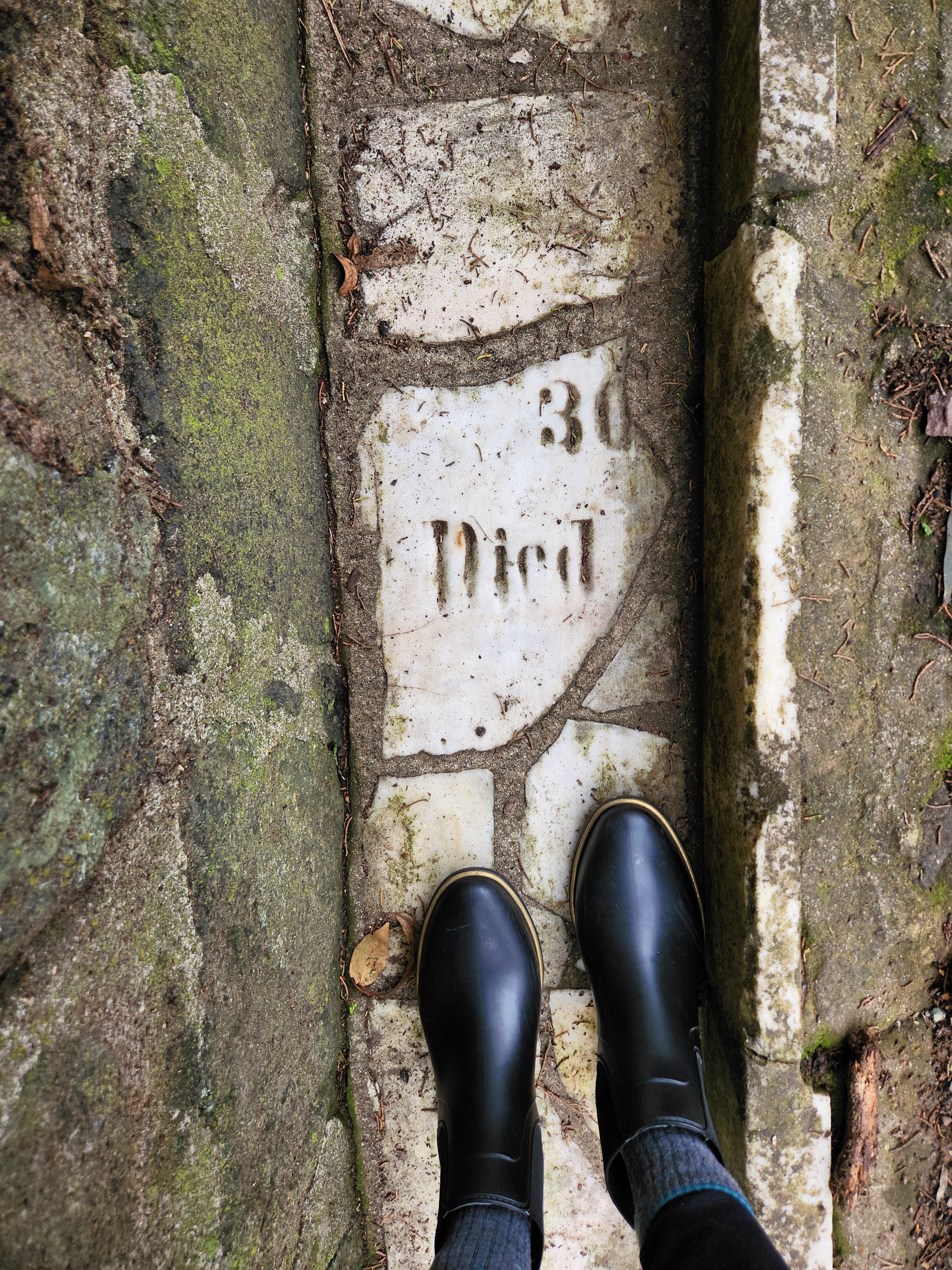
WPA workers used these marble remnants to beautify the park’s rain gutters. The majority of broken grave markers were positioned face down, but a handful of them face up. You can make out bits of the carved epitaphs still today.
I have to believe a few WPA workers intentionally ignored stone-laying instructions, just like cemetery administrators ignored years of eviction pressure, in hopes of forcing future park patrons to pause and reflect.


Haight Street
After your meandering reflective jaunt, you’ll probably need caffeine, food, and a shopping break. These spots are just a four minute walk from Buena Vista Park.
Wake Cup
1476 Haight St
Sip on Vietnamese iced coffee, strawberry matcha, or lavender jasmine milk tea.
Sandy’s Muffulettas
1457 Haight St
Enjoy New Orleans-inspired comfort food. Vegetarian-friendly.
Relic Vintage
1475 Haight St
Pay your respects to 20th century fashion.
710 Collective
1644 Haight St
Sift through vintage, local art, plants, and records.
Last words: The city is a living memorial
The disinterment of bodies from four big graveyards in the 1930s freed up 162 acres for San Francisco’s living residents. But as you can imagine, it wasn’t a perfect sweep.
People are still being unearthed, like 3-year-old Edith Howard Cook, whose casket was inadvertently discovered beneath the former Odd Fellows Cemetery in 2016.
While shocking, these unearthings are fairly run-of-the-mill, especially in cities like Savannah or San Francisco. It’s actually a normal part of life and, I argue, a privilege — to be forced to look back on history, to learn, and to maybe even get to rectify something, rather than just charging ahead.
With gravestones sprinkled along coastlines and embedded in public parks, San Francisco seems to embrace this part of life, this privilege. The privilege of being haunted by inhabited by the past.
Sources
Beyond the Grave: How Old Tombstones Became Part of the Fabric of San Francisco by Rae Alexandra
Land of the Dead: How the West Changed Death in America by Terry Hamburg
Regulating the Dead: Rights for the Corpse and the Removal of San Francisco’s Cemeteries by Lance Muckey
Yes, we sure would have !
Thanks for the additional info.